# From Blueprint to Caribbean Breezes: How We Built a Multilingual Web Platform for 1/10th the Cost Using Gemini
Table of Contents
From Blueprint to Caribbean Breezes: How We Built a Multilingual Web Platform for 1/10th the Cost Using Gemini
We are witnessing a fundamental shift in how software is created. This isn’t just about automated code completion; it is about a new era of software craftsmanship where an experienced developer and an advanced Large Language Model (LLM)—specifically Google’s Gemini—work in tight coordination to build, optimize, and deploy complete production systems.
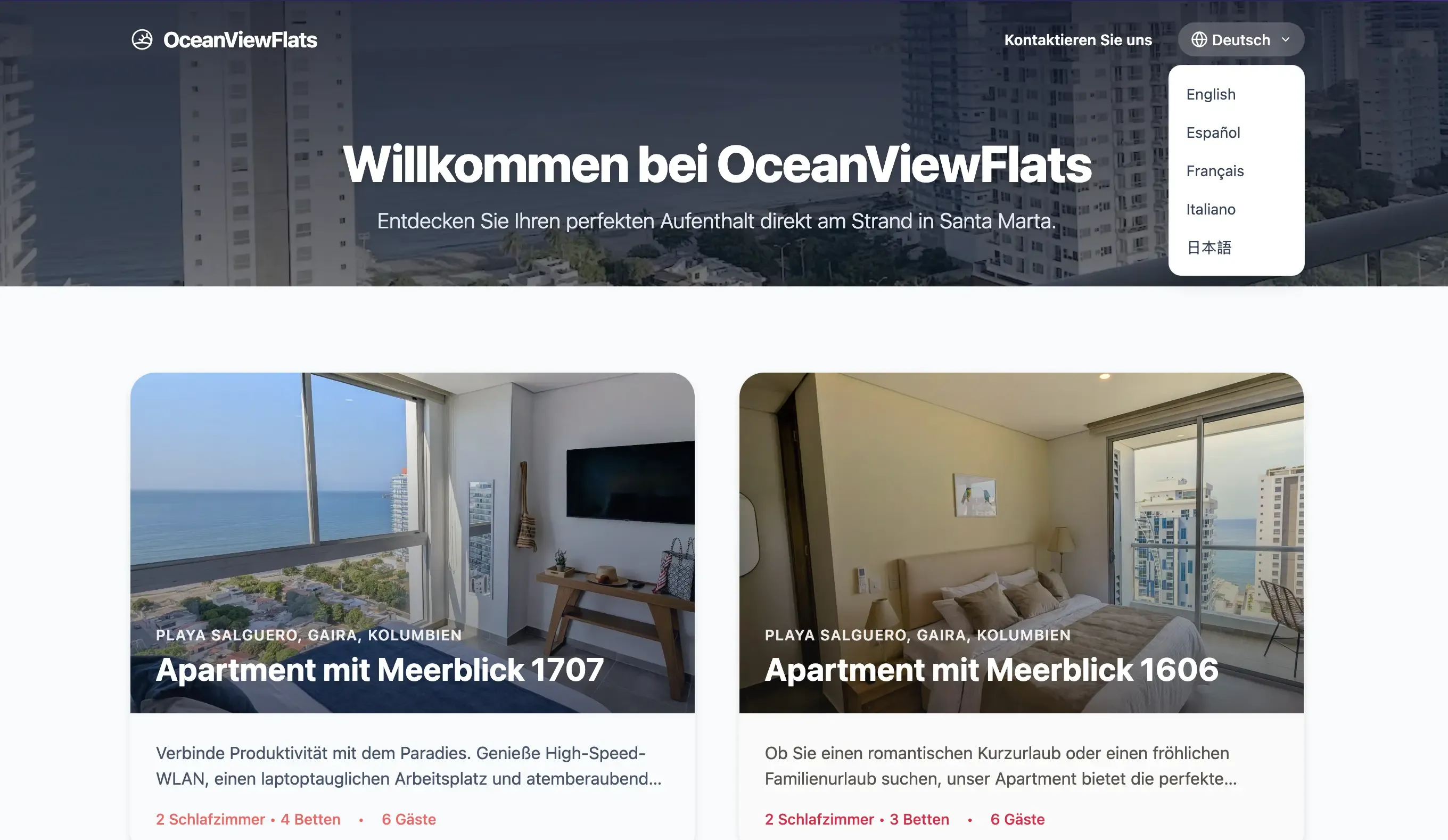
To illustrate this shift, let’s look behind the scenes at OceanViewFlats, a high-end, multilingual direct-booking web platform built for two premium vacation rentals in Santa Marta, Colombia. This project was developed almost entirely through an AI-human pair programming pipeline.
Below is an analysis of the problems this platform solves, the indispensable role of the expert developer guiding the AI, and a realistic cost comparison between traditional development and this new AI-first workflow.
🏖️ 1. The Key Problem: Direct Bookings vs. Platform Fees
In the vacation rental industry, property owners face a persistent dilemma. Platforms like Airbnb and Booking.com provide incredible global reach but charge steep commission rates—often between 12% to 20% split between the host and the guest. For a premium stay, these platform fees can add hundreds of dollars to a single booking, driving up costs for travelers and eroding margins for owners.
To bypass these fees, properties need a direct booking channel. However, a successful direct booking website cannot just be a simple, generic template. It must solve several complex challenges simultaneously:
- Multilingual Friction: Premium properties attract an international audience. OceanViewFlats needs to serve guests in 6 languages (English, Spanish, French, Italian, German, and Japanese) seamlessly, with automatic language detection and flawless localization.
- Extreme Performance & Mobile UX: Travelers often book on the move. The site must load instantly, use compressed modern image formats (like WebP) to prevent heavy bandwidth consumption on mobile networks, and remain fully interactive under poor cellular coverage.
- Traditional & Generative Search Visibility (SEO/GEO): The site must rank on traditional search engines (Google, Bing) and, crucially, be easily extracted by generative answer engines (ChatGPT, Perplexity, Claude, and Google SGE) when users ask queries like, “Show me beachfront apartments in Santa Marta with high-speed Wi-Fi and direct bookings.”
OceanViewFlats solves these problems with a statically compiled, high-performance architecture built in React, TypeScript, and Vite. It generates 24 independent, localized page variations, serves highly optimized WebP thumbnails, and embeds deep, multi-entity structured schemas.
🧠 2. The Vital Need for Expert Developer Guidance
There is a common misconception that LLMs can build complex software autonomously from a simple one-sentence prompt. In reality, letting an AI build code without expert oversight almost always results in a fragile “Minimum Viable Product” full of technical debt, accessibility gaps, and unoptimized assets.
Getting premium, production-ready results from Gemini requires expert developer instructions. In this project, the developer acted as the architect, auditor, and validator:
- Architecting the Static Generation Pipeline:
Instead of choosing a heavy, expensive server-side framework, the developer directed the AI to build a custom static pre-rendering compiler using React, TypeScript, and a simple Node script (
render.tsx). This kept the hosting costs at absolute zero while ensuring maximum SEO indexability. - Enforcing Premium Engineering Principles:
When implementing the mobile-responsive features, the developer didn’t accept basic “hide-on-mobile” shortcuts. They instructed the AI to design a persistent, sticky, horizontally swipeable specification bar that stacks perfectly below the navigation bar, complete with custom CSS utility classes like
scrollbar-noneto prevent visual clutter. - Optimizing Asset Pipelines:
An AI will happily reference massive 5MB source images in a gallery. The developer directed a batch compilation utilizing
imagemagickto generate compressed WebP thumbnails and set up native lazy-loading and fetch priorities (fetchPriority="low"andfetchPriority="high") to slash first-load page weight by over 92%. - Implementing Advanced GEO (Generative Engine Optimization):
A novice might ask for standard search tags. The expert developer instructed Gemini to write a deep, multi-entity JSON-LD schema using schema graphs (
@graph). This mapped the brand entity (LodgingBusiness) on the Home page and exposed specific, high-extraction attributes (bedrooms, bathrooms, and nightlyAggregateOfferpricing structures) on the property pages—precisely the signals that AI search crawlers use to extract answers for user queries.
Without the expert developer’s guidance, the AI would not know what to optimize or how to build it cleanly. The developer provides the standards, structural vision, and constraints; the AI provides the raw, high-speed execution.
💵 3. Cost Analysis: Traditional vs. AI-Disruptive Workflows
To understand the economic disruption of this workflow, let’s compare the real-world costs of building the OceanViewFlats platform using traditional agency development versus the AI-assisted pipeline.
The Scope of Work
- A custom, responsive, statically generated multilingual website (6 languages: EN, ES, FR, IT, DE, JA).
- 4 core pages (Home, Flat 1707, Flat 1606, Contact) generating 24 static HTML variants.
- Deep SEO/GEO optimization: bidirectional
hreflangmaps, dynamic Open Graph localized alternates, dynamic sitemap compiler, and robust multi-entity JSON-LD schemas. - Interactive, responsive lightbox gallery with optimized asset pipelines (WebP compression).
Traditional Development Approach
In a traditional agency setting, this project would require a Senior Front-End/Full-Stack Engineer, a QA Analyst, and a Project Manager/Designer.
| Phase / Role | Estimated Human Hours | Hourly Rate (USD) | Total Cost (USD) |
|---|---|---|---|
| UX/UI Design & Copywriting | 12 hours | $75 / hr | $900 |
| Front-End Development & Compiler Setup | 45 hours | $100 / hr | $4,500 |
| Multilingual Copy & Translation Setup | 10 hours | $75 / hr | $750 |
| SEO/GEO Schema Engineering | 8 hours | $100 / hr | $800 |
| QA, Mobile Testing & Deployment | 10 hours | $75 / hr | $750 |
| Project Management / Overhead | 8 hours | $80 / hr | $640 |
| TOTALS | 93 Hours | — | $8,340 USD |
Time-to-market: 3 to 5 weeks.
AI-Assisted Disruptive Workflows (Using Gemini)
In this model, a single Senior Software Engineer directs Gemini (using tools like Antigravity) to write the code, compile pages, compress assets, and structure schemas.
| Phase / Resource | Actual Human Hours | Hourly Rate / Tool Cost (USD) | Total Cost (USD) |
|---|---|---|---|
| Gemini Pro / Flash API & Tooling Fees | — | Token usage & licensing | $15 |
| Expert Engineer Prompting & Architecture | 3.5 hours | $100 / hr | $350 |
| Expert Auditing, Schema Validation & QA | 1.5 hours | $100 / hr | $150 |
| Deployment & Verification | 1.0 hours | $100 / hr | $100 |
| TOTALS | 6.0 Hours | — | $615 USD |
Time-to-market: 1 to 2 days.
Financial Comparison Summary
| Metric | Traditional Workflow | AI-Assisted Workflow | Difference |
|---|---|---|---|
| Financial Cost | $8,340 USD | $615 USD | 92.6% Cost Reduction |
| Total Human Hours | 93 Hours | 6 Hours | 93.5% Time Savings |
| Delivery Time | 21 - 35 Days | 1 - 2 Days | Over 15x Faster |
🏁 4. Conclusion: The Future is Symbiotic
The OceanViewFlats project demonstrates that AI-driven development is no longer a future promise—it is a current, highly disruptive reality. Achieving a 92% reduction in costs and accelerating delivery from weeks to hours changes the unit economics of web development. It makes bespoke, premium, highly optimized software accessible to small businesses and property owners who previously had to settle for generic, unoptimized site-builders.
However, the most significant takeaway from this exercise is that AI does not replace human expertise; it acts as a massive force multiplier for it.
An AI model has access to vast amounts of coding syntax, but it lacks real-world contextual awareness, business intuition, aesthetic taste, and strict engineering standards. It doesn’t know that a sticky navigation bar might overlap a property details bar unless directed to check. It doesn’t know how to structure schema graphs to establish local business authority for AI agents unless an expert understands those indexing nuances.
This new way of working is here to stay. The developers who thrive in this next decade will not be those who write code the fastest, but those who are expert instructors—engineers who can conceptualize elegant architectures, direct AI models with high precision, audit output with a critical eye, and translate complex human business requirements into flawlessly executed digital experiences.